Why Peptide Stores Get Rejected: FDA, Payment Processors and the “Research Use Only” Myth
There's no such thing as an FDA-approved peptide website. Here's what the FDA, FTC, payment processors and platforms actually look at, what 2026's warning letters show, and the red flags to fix.
Peptide store owners often ask how to get their store “FDA approved.” It’s the wrong question, and believing it can cost you your store. No FDA approval exists for a peptide website. What matters is how your store looks to the people who can shut it down: the FDA, the FTC, your payment processor and your platform.
This guide explains what each of them looks at, what 2026’s FDA warning letters show about how they read peptide websites, and the website issues that get stores rejected most often.
This article is general information for store owners, not legal or regulatory advice. Peptide rules vary by product and country and change often. Review your products, wording and policies with qualified legal counsel.
First, the “FDA approved” myth
Research peptides sold online are generally not FDA-approved drugs. A small number of peptides are approved as specific prescription medicines, but that approval covers that drug from that manufacturer. It doesn’t extend to research-grade powder sold by a third party.
That’s why your website should never say or suggest that your products are “FDA approved,” “FDA registered” or “FDA compliant.” The FTC specifically warns against misstating a product’s FDA status, and an underwriter who sees it will treat it as a red flag.
Who can reject your store, and what each one checks
| Who | What they can do | What they look at |
|---|---|---|
| FDA | Warning letters, and further enforcement if issues aren’t fixed | Whether your website shows the products are meant for human use |
| FTC | Action over deceptive or unsupported health claims | Benefit claims, testimonials, influencer promotion |
| Payment processors | Decline your application, freeze funds or close your account | Your product pages, disclosures, policies and chargeback risk |
| Platforms and hosts | Remove your store or site | Their own acceptable use policies |
Most store owners only find out a processor or platform has a problem after it acts. The good news is that all four are reading the same thing: your website.
How the FDA decides what you’re selling
The FDA’s key question is intended use. If the evidence shows a product is meant to treat a condition or affect the body, the FDA can treat it as a drug. An unapproved drug can’t legally be sold.
The FDA looks for that evidence in your whole website, not just your labels. That’s why a “research use only” line doesn’t settle anything on its own.
What 2026’s warning letters show
In 2026, the FDA sent a series of warning letters to online peptide sellers. Seven letters dated March 31, 2026 were published in April, and another followed in August. These sellers relied on “research use only” or “not for human use” labels, and the FDA didn’t accept them as a defense. In one letter, the FDA wrote that “evidence obtained from your website establishes that your products are intended to be drugs for human use.”
The evidence the FDA cited came from the sellers’ own websites:
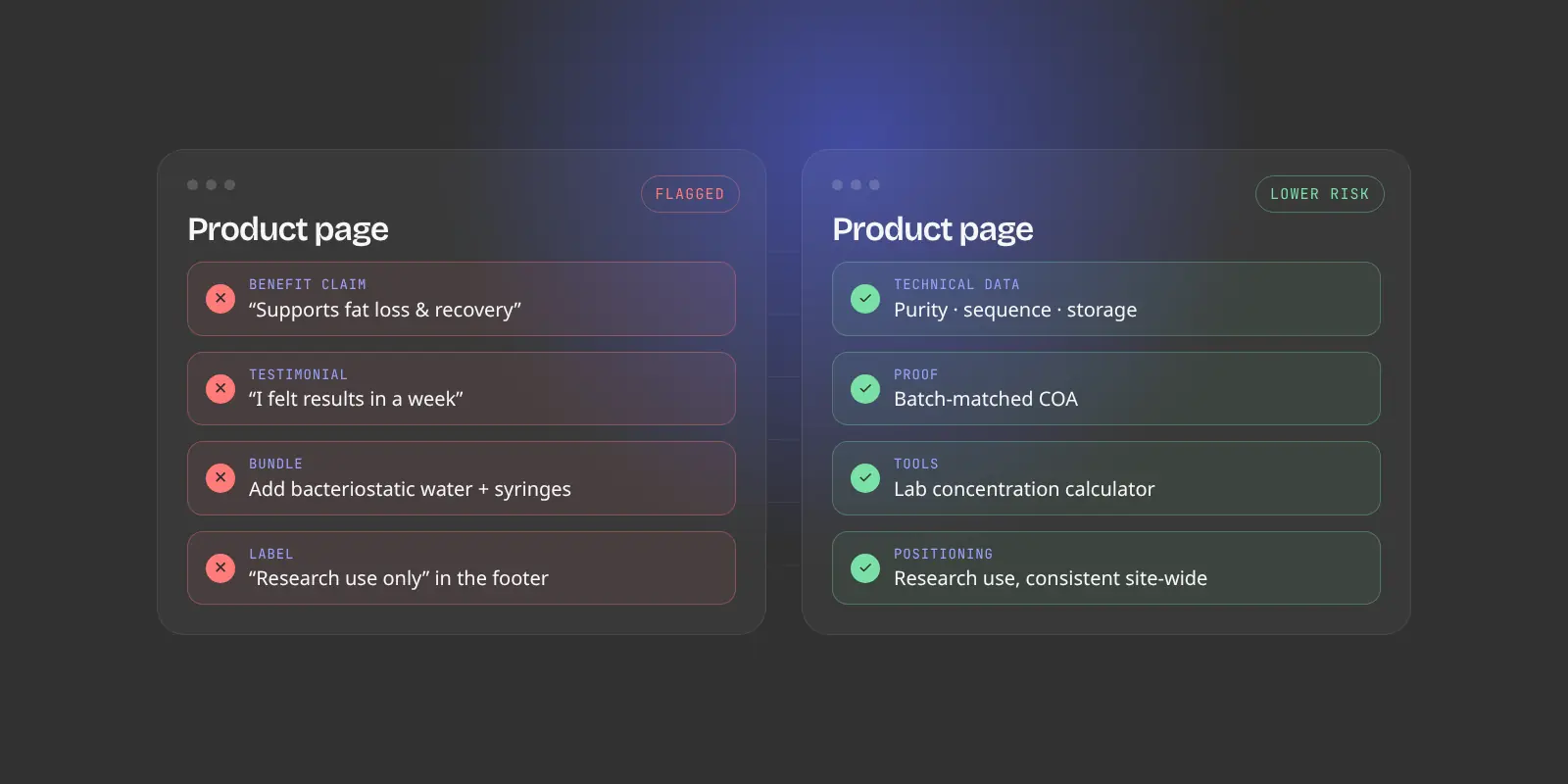
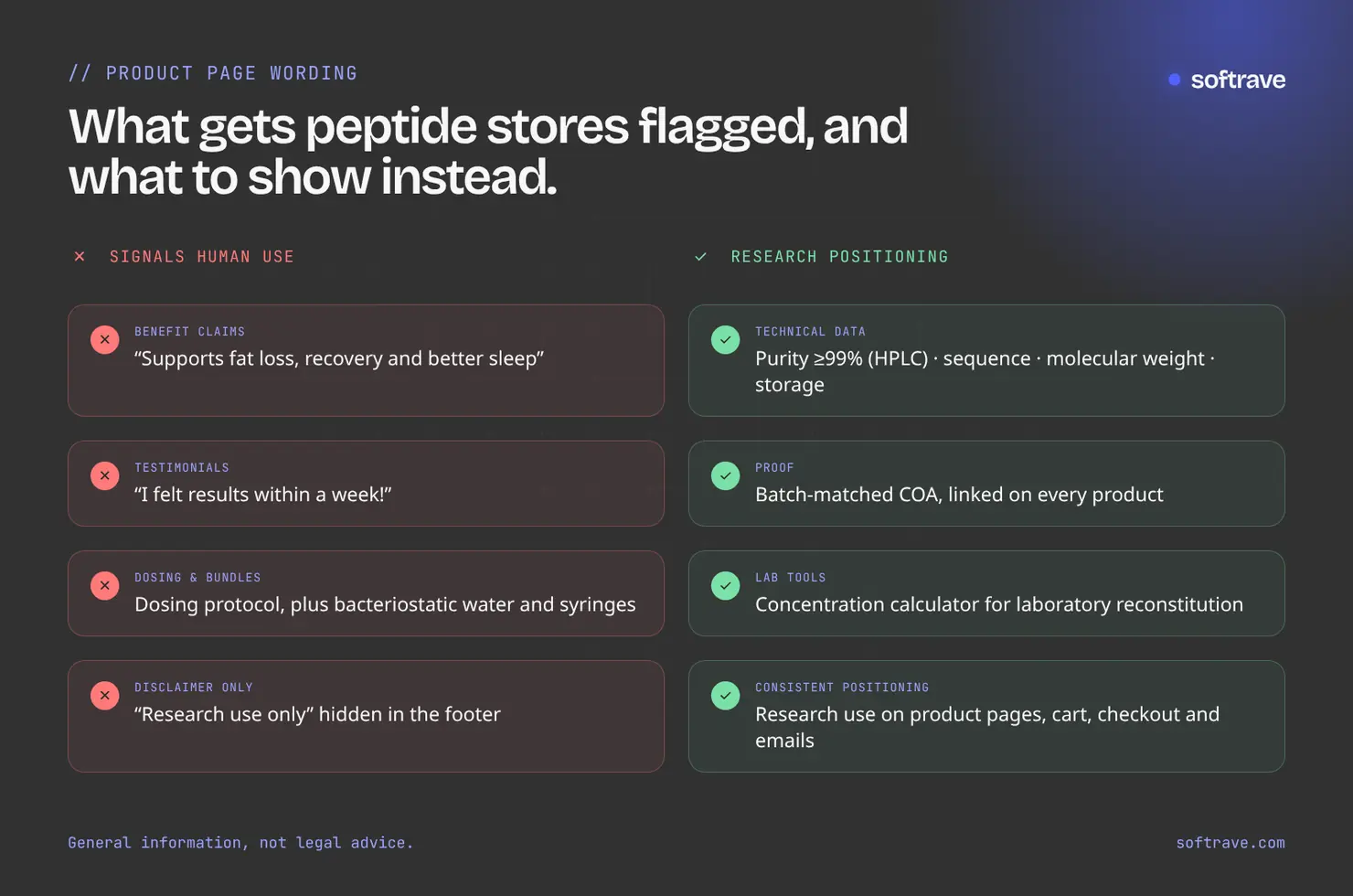
- Benefit language on product pages, such as appetite, weight loss, metabolism or “liver health”
- Study summaries used as sales copy, even carefully worded ones like a study “suggests” a “potential benefit”
- Customer testimonials describing personal results
- Bacteriostatic water sold alongside peptides, which the FDA read as a way to prepare an injectable drug
- Coded product names that clearly pointed to approved drugs
- Imagery and layout aimed at consumers rather than researchers
The lesson: a disclaimer can’t fix a page whose overall message is “this will help you.”
What about the 2026 Category 2 changes?
In April 2026, the FDA announced it would remove 12 peptides from “Category 2” of its compounding list, the group flagged for significant safety concerns, and scheduled advisory committee meetings to review peptides for compounding.
Some sellers have presented this as approval. It isn’t. These lists cover compounding pharmacies, which work under their own legal framework. Leaving Category 2 doesn’t make a peptide an approved drug, and it doesn’t make it legal to market research-grade peptides for human use. Don’t reference it on your product pages as if it does.
Why payment processors decline peptide stores
Mainstream processors such as Stripe, PayPal and Square treat research peptides as high-risk or prohibited, so most stores need a high-risk processor. Those processors approve peptide stores, but they underwrite carefully. The most common reasons for a decline or a later freeze:
- Inaccurate disclosure. Describing the business vaguely (“health products,” “supplements”) to get approved is the fastest route to a frozen account once the catalog is reviewed.
- Human-use signals on the site. The same issues the FDA cites above. Underwriters read product pages.
- Missing or weak policies. No clear terms of sale, refund policy, shipping policy or research-use terms.
- No proof of product quality. Missing COAs, or COAs that don’t match the batch being sold.
- Chargeback risk. Unclear billing descriptors, slow fulfillment and poor customer communication all raise disputes.
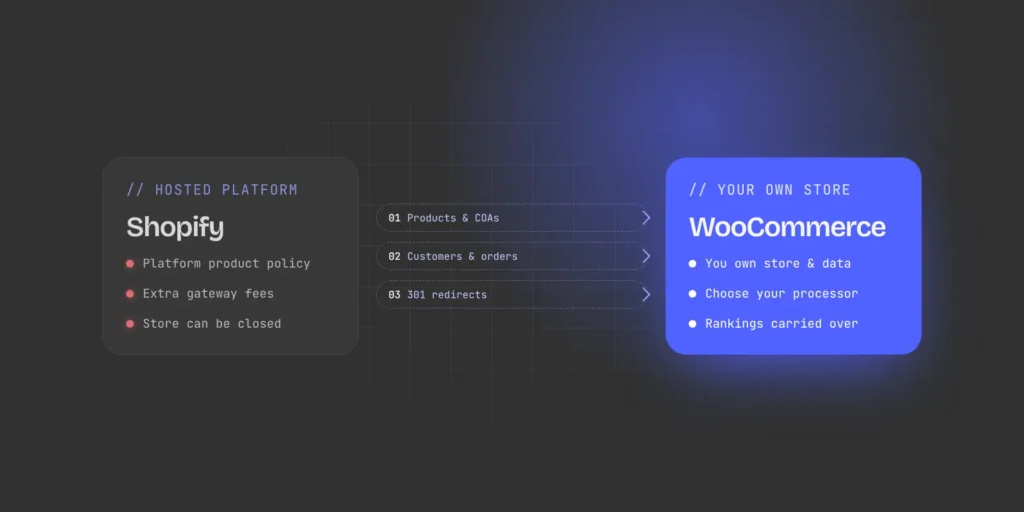
Platforms add their own layer. Shopify, for example, can close a store under its acceptable use policy regardless of which processor you use. We covered that in our guide on migrating a peptide store from Shopify to WooCommerce.
Website red flags to fix now
Review your store against this list. Each item is something regulators or underwriters have flagged:
- Any claim or hint of a health benefit, weight loss or “results”
- Dosing instructions, protocols or “how to use” content
- Testimonials or reviews describing personal use
- Study summaries written as product benefits
- Bacteriostatic water, syringes or injection supplies bundled or cross-sold with peptides
- Product names that are codes for approved drugs
- Photos of people, before-and-after images, syringes or lifestyle imagery
- “FDA approved,” “FDA registered” or “pharmaceutical grade” wording used loosely
- Influencer or affiliate promotion without disclosure, or that implies personal use
- Calculators or tools framed as dosing guides rather than lab concentration tools
What a lower-risk peptide store looks like
No website can make a store risk-free. But stores that hold up to review tend to share a few traits:
- Consistent research-use positioning on product pages, in the cart, at checkout and in emails. The labels and the message agree.
- Technical, not promotional, product content: sequence, purity, molecular weight, storage and handling.
- A batch-matched COA on every product, easy to find and verify.
- Complete, visible policies, including research-use terms customers accept at checkout.
- Lab-style tools, such as a reconstitution calculator presented as a concentration tool for research.
- Accurate disclosure to your processor, host and platform from day one.
Remember: website changes reduce the signals that get stores flagged. They are not a substitute for regulatory authorization or legal advice.
Get a free store health check
Softrave builds and reviews peptide store websites. Our free store health check goes through your site for the issues above, including wording, imagery, policies, COAs and checkout, and gives you a clear list of what to fix. If you need a new build or a rebuild, see our peptide store website development service.