Peptide Store Policies: The Pages You Need Before Applying for Payments
The policy pages and checkout elements payment processors and card networks expect from a research peptide store, what each should cover, and common mistakes.
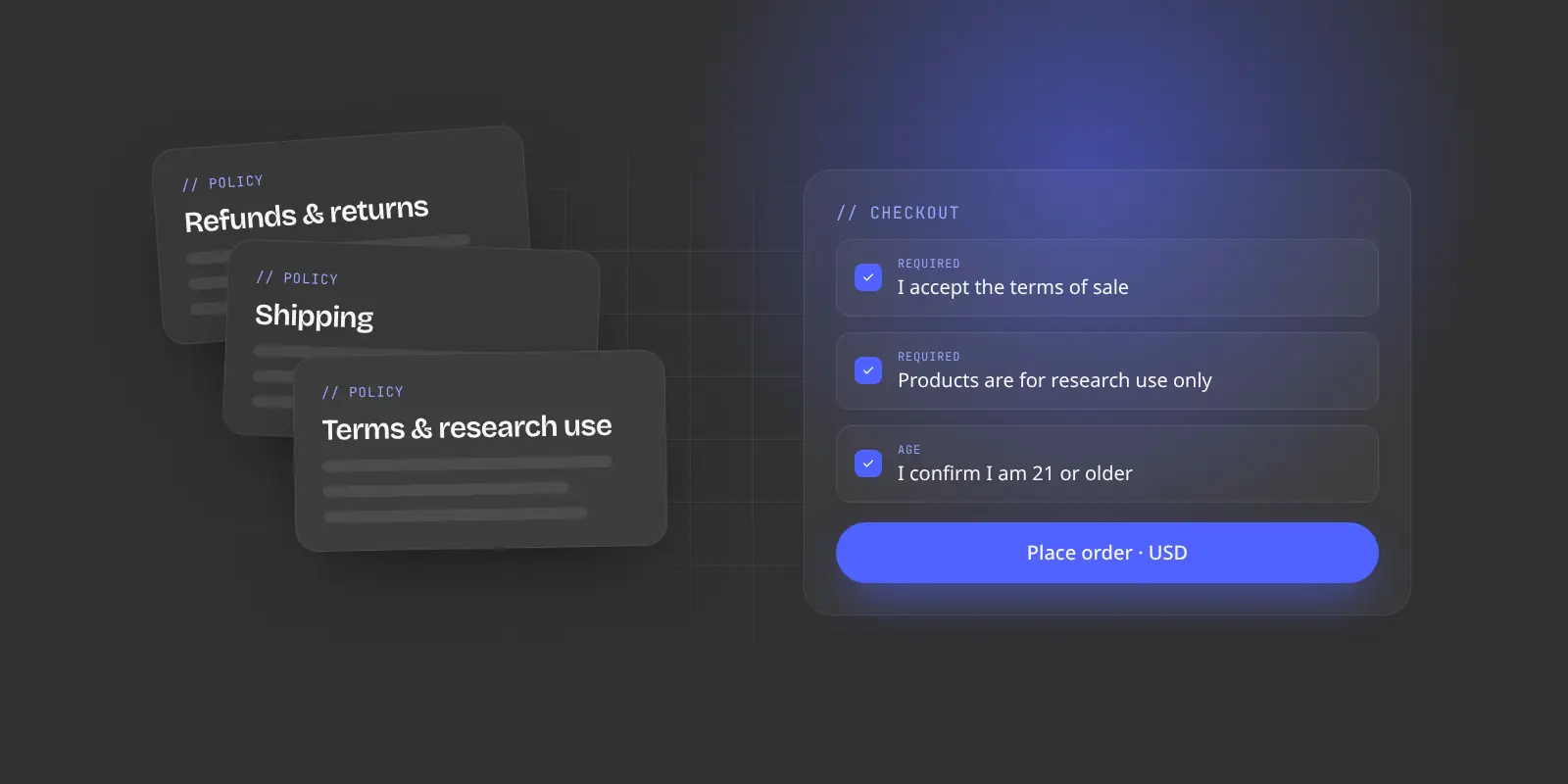
Every peptide store needs terms of sale, a research use policy, refund and returns, shipping, privacy and contact pages, plus a cookie notice for UK and EU visitors. Make them visible at checkout with a required terms checkbox, age confirmation and prices shown in USD, and have counsel review the final wording.
Policy pages are the least exciting part of a peptide store, and among the first things a payment processor checks. Underwriters look for them when they review your application. Card network rules expect them. And when a customer disputes a charge, your policies are part of the evidence.
This guide lists the pages every research peptide store should have, what each one should cover, and how to make them visible where they count.
This is general information, not legal advice. Policies are legal documents. Use this as a checklist and have your own counsel write or review the final wording for the markets you sell to.
Why policies matter more for peptide stores
- Processors check them. High-risk underwriters review your live website. Missing or thin policies are a common reason for delays and declines.
- Card networks expect them. Processors generally require merchants to show contact details, product descriptions, refund and delivery terms, and a privacy policy.
- They reduce disputes. Clear terms set expectations before purchase. Many chargebacks start with a customer who didn’t know the refund or shipping terms.
- They support your research-use positioning. Your terms are where research-use conditions are formally set out and accepted.
The essential policy pages
1. Terms and conditions of sale
Your main legal agreement with buyers. It typically covers who can buy, how orders are accepted, pricing and payment, the research-use conditions of sale, limits of liability, and which law applies. It’s also the page customers agree to at checkout.
2. Research use policy
A clear, standalone statement of how your products are sold: for laboratory research only, not for human or veterinary use, and not intended to diagnose, treat or prevent any condition. Keep it consistent with your product pages. As the FDA’s 2026 warning letters showed, this statement only carries weight when the rest of your site matches it.
3. Refund and returns policy
State when refunds are given, how to request one and how long it takes. Peptide stores often limit returns on opened products for quality reasons, so say so clearly, and explain what happens with damaged or incorrect orders.
4. Shipping policy
Cover where you ship, delivery methods and times, costs, packaging and storage in transit, what happens to lost or damaged parcels, and any countries you don’t ship to.
5. Privacy policy
Explain what customer data you collect, how you use it, who you share it with (payment, shipping and email providers) and how customers can request access or deletion. Privacy laws vary by country and state, so make sure yours covers the markets you sell to.
6. Contact and business details
Show your business name, the name that appears on card statements, a support email and, ideally, a phone number and business address. Easy contact options head off disputes, and processors expect them.
7. Cookie notice
If you sell to the UK or EU, you’ll usually need a cookie notice and consent banner for tracking and analytics cookies.
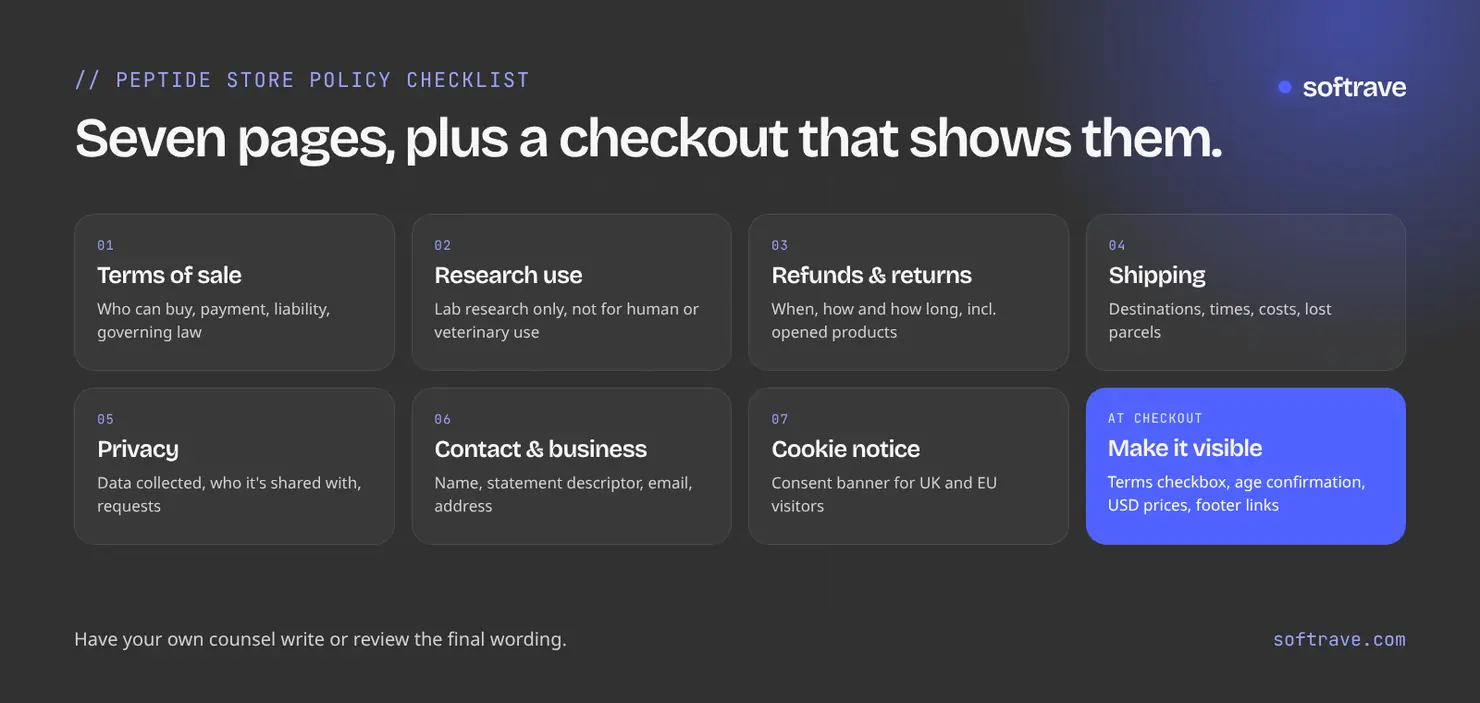
Checkout essentials
Policies only help if customers see them. At checkout:
- A required checkbox confirming the buyer accepts your terms and research-use conditions, with links to both
- Age confirmation, such as a 21+ age gate on entry or a checkbox at checkout, whichever fits your markets and processor
- Prices shown with the currency (USD, not just “$”)
- Shipping costs and estimated delivery before payment
- A clear billing descriptor note, so customers recognize the charge on their statement
- Policy links in the footer on every page
Common mistakes
- Copying another store’s policies. They won’t match your business, and processors notice copied text with the wrong company name or country.
- Policies that contradict the site. A research-use policy alongside product pages with benefit claims undermines both.
- Hiding policies. A refund policy that’s only reachable through a footer link on one page isn’t enough.
- Out-of-date details. Old shipping times, addresses or email addresses cause disputes.
- No acceptance record. Without a checkbox at checkout, it’s harder to show a customer agreed to your terms.
Policy checklist
- Terms and conditions of sale
- Research use policy
- Refund and returns policy
- Shipping policy
- Privacy policy
- Contact page with business details
- Cookie notice (UK and EU)
- Terms and research-use checkbox at checkout
- Age confirmation
- Policy links in the footer on every page
- Legal review of the final wording
Get your policy setup reviewed
Softrave builds peptide stores with the full policy structure in place: policy pages, checkout acceptance, age gate and footer links, ready for your counsel’s final wording. Our free store health check flags missing or inconsistent policies along with other underwriting issues. See also our peptide payment processing guide and our peptide store website development service.
Frequently asked questions
What policy pages does a peptide store need?
Terms and conditions of sale, a research use policy, refund and returns, shipping, privacy, a contact page with business details, and a cookie notice if you sell to the UK or EU.
Do payment processors check a peptide store's policies?
Yes. Underwriters review your live website, and missing or thin policies are a common reason for delays and declines. Processors generally expect contact details, refund and delivery terms and a privacy policy.
Does a peptide store need an age gate?
Many do, either a 21+ age gate on entry or an age confirmation at checkout. Which approach fits depends on your markets and your processor's requirements.
Can I copy another peptide store's policies?
It's a bad idea. Copied policies rarely match your business, and processors notice text with the wrong company name or country. Use a checklist and have counsel write or review the final wording.